


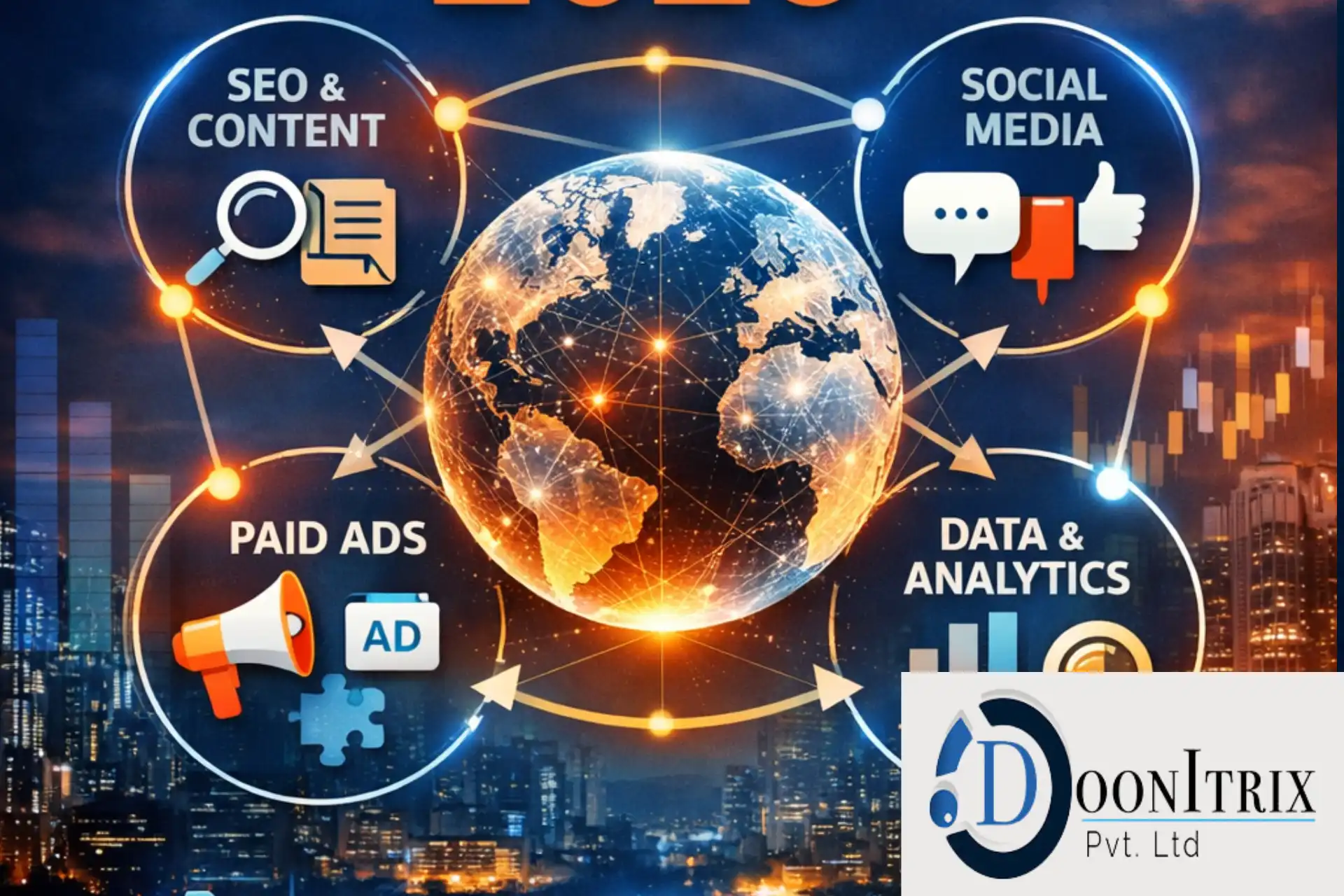
As a marketing leader in 2026, you are navigating an unprecedented landscape. Your customers are inundated with messages across a growing number of platforms—AI Overviews in Google, personalized results in ChatGPT, social commerce on TikTok, and a fragmented media ecosystem of connected TV (CTV) and traditional channels. The common response has been to allocate budget and resources channel by channel, but this approach is now fundamentally broken. This article argues that the only path to sustainable growth, reliable measurement, and competitive advantage in 2026 is through a fully integrated digital marketing strategy. We will explore why an Integrated Digital Marketing Strategy has moved from a best practice to a strategic imperative, the Multi-Channel Marketing and Customer-Centric Approach required, and how agencies like DoonITrix are engineering these systems to drive predictable Digital Marketing ROI.
Part 1: Understanding the Crisis of Disconnected Marketing
What Is an Integrated Digital Marketing Strategy and Why Is It Critical for 2026?
An Integrated Digital Marketing Strategy is the convergence of your brand’s message, data, and customer experience across every digital touchpoint. It moves beyond simple coordination to create genuine synergy, where the combined effect of your efforts is far greater than the sum of its parts.
The urgency for this Holistic Marketing Approach is driven by the modern consumer journey, which is non-linear and fragmented. A customer may discover a brand through a social media video, research it via a Google AI Overview or ChatGPT query, read a review on Reddit, and finally convert after receiving a retargeting ad or an email. A siloed, channel-by-channel approach creates a jarring experience for this consumer. They encounter inconsistent messaging, conflicting offers, and a brand that feels disjointed rather than unified. This inconsistency erodes Brand Consistency & Trust, increases customer acquisition costs, and makes measuring true Digital Marketing ROI nearly impossible.
What Does the 2026 Customer Journey Demand?
In 2026, the journey is not just multi-channel; it is increasingly “zero-click” and conversational. The rise of AI search interfaces like AI Overviews and AI Mode on Google, and the deep integration of LLMs like ChatGPT, means brand discovery and evaluation often happen without a single website visit. Your visibility in these environments is no longer dictated by a single keyword ranking but by a complex web of Brand Authority, Trust Signals, and comprehensive topic coverage that spans your website, digital PR, social proof, and third-party platforms like Reddit and Instagram.
This environment demands a Cross-Channel Strategy that synchronizes paid, owned, and Earned Media into a single narrative. Your Content Marketing efforts must serve as the foundational “infrastructure,” with assets strategically atomized and adapted for each platform. A Digital PR campaign that earns media coverage builds the authority signals that boost your Search Engine Optimization (SEO) and increase visibility in AI-driven search results. This interconnectedness is the core of an Integrated Marketing 2026 strategy.
Part 2: The Strategic Pillars of an Integrated Approach
Building a successful integrated strategy rests on three non-negotiable pillars, each designed to eliminate friction and unify effort.
Pillar A: Unified Customer Data and Multi-Touch Attribution
The first step is breaking down data silos. Unified Messaging to the customer is impossible without a unified view of the customer. This requires integrating your CRM with all marketing platforms—advertising, email, and website analytics—to create a single source of truth.
Crucially, you must abandon last-click attribution models. These models incorrectly assign all value to the final touchpoint, undervaluing the top-of-funnel Awareness work done by Content Marketing and Social Media Marketing. Implementing a Multi-Touch Attribution model (e.g., linear or time-decay) allows you to see how channels work together to guide the Customer Journey, enabling smarter budget allocation and proving the value of your Holistic Marketing Approach.
Pillar B: Cross-Channel Content Synchronization and the Atomization Strategy
Content is the fuel for your integrated engine. Synchronization means maintaining a Cohesive Brand Identity and core narrative while adapting the message for the format and context of each channel.
A powerful tactic here is Content Atomization. Start with a substantial piece of “pillar” content, such as a research whitepaper or a comprehensive guide. This pillar asset is then broken down (atomized) into dozens of smaller, platform-specific assets:
-
An Email Marketing campaign offering a gated download of the whitepaper.
-
A series of short-form videos for social media summarizing key findings.
-
Multiple blog posts and Social Media posts diving into specific data points.
-
Paid search ads targeting keywords related to the core topic.
This ensures Brand Consistency and Unified Messaging across every interaction, from a LinkedIn post to a Google Ads headline.
Pillar C: Agile Technology, Automation, and AI-Powered Marketing
Managing integration manually at scale is impossible. The complexity demands a connected technology stack where platforms communicate via APIs, enabling real-time data flow and automated actions. For instance, when a lead downloads your whitepaper, that action in the CRM can automatically trigger their addition to a specific email nurture sequence and exclude them from a top-of-funnel awareness ad campaign.
Furthermore, AI-Powered Marketing tools are becoming essential for optimization. AI can analyze performance data across all channels to recommend real-time budget shifts, identify high-performing audience segments, and even generate insights for creative adjustments. This level of Marketing Integration turns your strategy into a self-optimizing system focused on Maximizing ROI.
Part 3: Implementing Your 2026 Integrated Strategy: A Practical Framework
Transitioning to an integrated model is a deliberate process. For executives and CMOs, the following framework provides a roadmap.
Step 1: Conduct a Comprehensive Ecosystem Audit
You cannot integrate what you do not fully understand. Begin with a rigorous audit:
-
Data Discrepancy Analysis: Compare key metrics (leads, revenue) across Google Analytics, your CRM, and ad platforms. Identify where the numbers don’t align—this is a primary source of friction.
-
Customer Journey Mapping: Trace the path of a high-value customer. Document every touchpoint and identify where messaging becomes inconsistent or where drop-offs occur.
-
Technology Stack Review: Catalog every marketing and sales tool. Eliminate redundancy and prioritize platforms that offer robust integration capabilities.
Step 2: Develop a Unified Measurement Dashboard
Marketing Integration requires a “single pane of glass” for performance reporting. This executive dashboard must shift focus from channel-specific vanity metrics (likes, impressions) to business-outcome metrics.
-
Track Macro-Conversions: Focus on Target CPA, Customer Lifetime Value (CLV), and overall Return on Ad Spend (ROAS).
-
Funnel Visibility: View performance by stage (Awareness, Consideration, Decision) to diagnose bottlenecks.
-
Cross-Channel Insights: The dashboard must answer questions like, “How did our recent Digital PR campaign impact the conversion rate of our branded Paid Search terms?”.
Step 3: Execute Integrated Campaigns with a Unified Brief
Move from independent channel campaigns to orchestrated launches. All teams—SEO, content, paid media, social, PR—should work from a single Unified Brief that details the core campaign message, target persona, and primary conversion goal.
-
Dynamic Retargeting: Use engagement from one channel to inform messaging in another. For example, users who watched 50% of a YouTube explainer video can be served a Display Ad featuring a customer case study or a special offer.
-
Budget Fluidity: Establish rules for dynamic budget reallocation. If a social media awareness campaign is efficiently driving high-intent traffic, budgets can be automatically increased, while underperforming search segments are scaled back.
Conclusion: Integration as the Foundation for Predictable Growth
The fragmented, siloed marketing model is obsolete. In 2026, with its AI-driven search, fragmented media landscape, and non-linear customer journeys, an Integrated Digital Strategy is the only reliable way to build Brand Consistency & Trust, achieve Competitive Advantage, and realize predictable, scalable Digital Marketing ROI. It is a commitment to speaking with one clear, powerful voice across the entire digital ecosystem, ensuring that wherever and however your customer encounters your brand, the experience is seamless, trustworthy, and compelling.
Frequently Asked Questions (FAQ)
Q1: What is the difference between multi-channel marketing and an integrated strategy?
Ans: Multi-channel marketing simply means being present on multiple platforms. An integrated strategy ensures all those channels are strategically aligned, sharing data and working toward a unified goal with consistent messaging. It’s the difference between having multiple radios playing different songs and an orchestra performing a symphony.
Q2: How long does it take to see results from an integrated marketing approach?
Ans: Some results, like improved internal alignment and clearer data, can be immediate. However, significant impacts on key metrics like customer lifetime value (CLV) and overall ROI typically build over several months as campaigns synchronize and data accrue to inform optimization. It is a strategic investment, not a tactical quick fix.
Q3: Isn’t an integrated strategy only for large enterprises with big budgets?
Ans: No. While large companies may have more complex silos to break down, the principles of integration—unified messaging, content repurposing, and connected data—are scalable. For small and medium businesses, integration often leads to more efficient budget use by eliminating wasteful, conflicting campaigns and providing clearer insight into what truly drives growth.
Q4: How does DoonITrix Pvt. Ltd. help with its Integrated Digital Marketing Approach?
Ans: At DoonITrix, we architect integrated marketing systems, not just execute isolated campaigns. Our approach begins with a deep audit of your existing ecosystem to identify friction points and opportunities. We then develop a Customized Strategy that aligns your Website Development, Search Engine Optimization (SEO), Public Relations (PR), and Content Marketing into a cohesive engine for growth. By serving as your single, strategic partner, we ensure Candid Communication, implement an Innovative Approach with the latest tools, and focus relentlessly on the Results-Oriented metrics that matter to your business, transforming your digital presence into a unified and powerful driver of predictable revenue